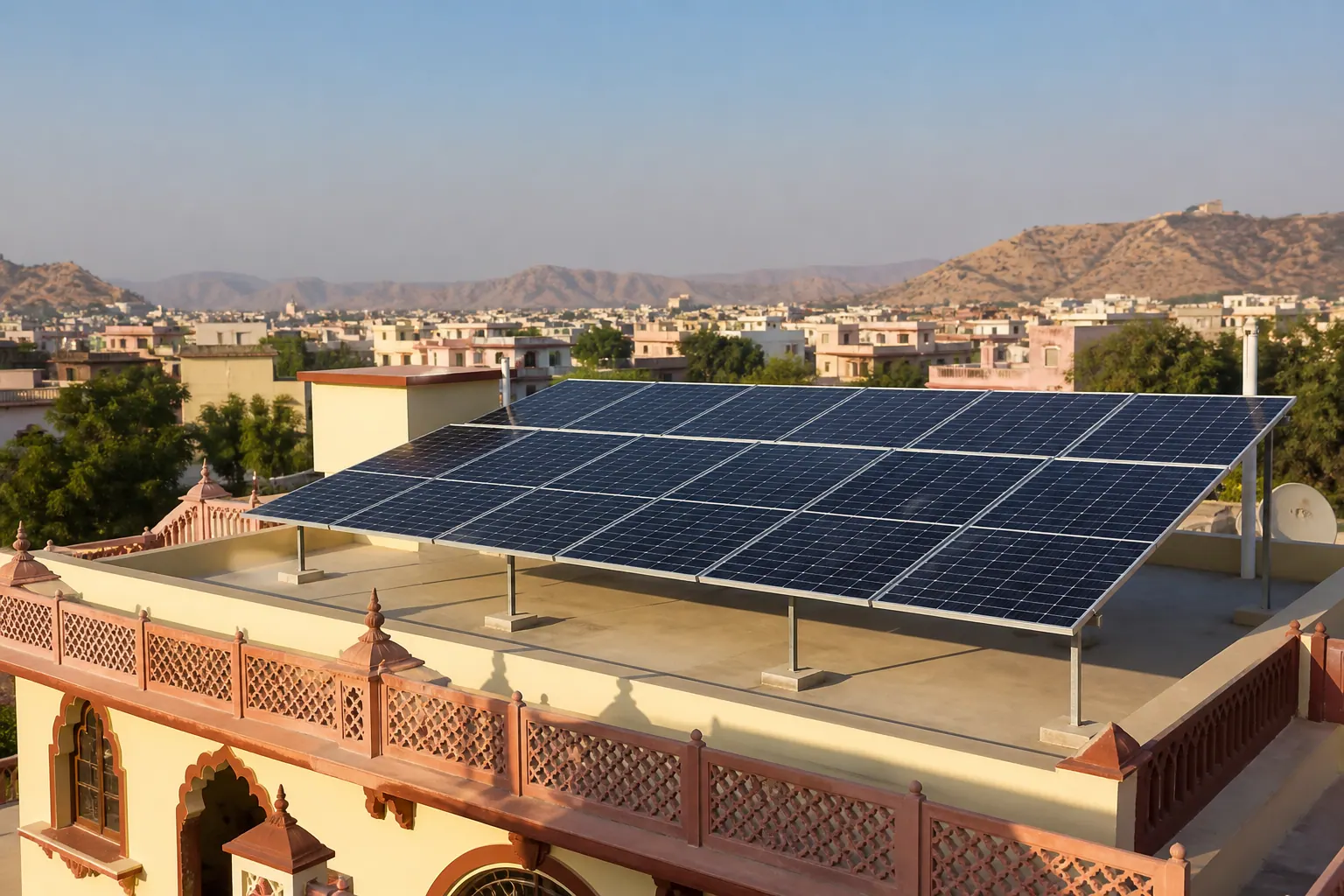
Why solar cost in Jaipur needs a local lens
Jaipur is one of India's strongest solar markets for a simple reason: abundant sunshine, rising electricity tariffs, and growing interest in rooftop systems for homes and businesses. When people search for Solar Panel Cost Jaipur, they usually want a clear answer—not a vague national average.
The honest answer is that cost depends on system size (kW), component quality, roof type, mounting structure, inverter choice, wiring, and whether you need special civil or electrical work. A transparent solar company will break these into line items during a site survey rather than quoting a single "per kW" number with no context.
This guide explains how residential and commercial pricing is typically structured in Jaipur, what drives the final quote, how subsidies and net metering affect net investment, and how to compare proposals without getting lost in marketing language. Use it alongside SolarOnn's solar calculator and a free consultation for a site-specific estimate.
What "cost per kW" usually includes
Most Jaipur homeowners see quotes framed as ₹ per kW for a complete rooftop package. A complete package typically covers:
- Solar modules (panels)
- Inverter (string or hybrid, depending on design)
- Module mounting structure sized for your roof wind load and orientation
- DC and AC cabling, earthing, and protection devices
- Installation labour and basic commissioning
- Documentation support for net metering / subsidy applications where applicable
What is often not included—or quoted separately—includes roof waterproofing repairs, significant shadow mitigation (tree trimming is separate), electrical panel upgrades, long cable runs, elevated structures for tin sheds, battery storage, and premium monitoring add-ons.
Always ask for a bill of materials with brand models, warranty terms, and what happens if a component is substituted.
Typical residential system sizes in Jaipur
Most Jaipur homes start with a system sized to their monthly bill and available roof area:
| Typical need | Common size range | Notes |
|---|---|---|
| Small apartment / low bill | 2–3 kW | Roof space and sanctioned load matter |
| Medium family home | 3–5 kW | Most common residential band |
| Larger villa / high consumption | 5–10 kW | May need stronger structure & larger inverter |
| High usage / EV + AC load | 10 kW+ | Confirm transformer / load with DISCOM |
Generation in Jaipur is generally strong year-round compared with many Indian cities, but actual output still depends on tilt, azimuth, soiling, and shade. A good design uses your bill history and a shade assessment—not only a rule of thumb.
Explore residential options on our residential solar installation in Jaipur page, and see real installs in the projects gallery.
Commercial and industrial pricing drivers
Commercial systems are priced differently because capacity, structure height, cable length, and downtime constraints vary widely. Factories, warehouses, schools, hotels, and offices often need:
- Higher capacity (tens to hundreds of kW)
- Elevated or custom mounting on metal roofs
- Three-phase design and protection coordination
- Phased installation to avoid business interruption
- Different commercial subsidy / accelerated depreciation considerations (policy-dependent)
For business-focused EPC, see commercial solar solutions in Jaipur.
Factors that change your final quote
1. Panel and inverter quality tier
Tier-1 modules with strong performance warranties cost more upfront but often deliver better long-term yield and support. Inverter brand, efficiency, and service network in Rajasthan matter as much as panel brand.
2. Roof type and structure
RCC flat roofs, sloping tiled roofs, and metal industrial sheds need different structures. Elevated structures for shade clearance or future waterproofing access add steel and labour cost.
Rooftop conditions can influence system planning and installation. Explore our approach to rooftop solar in Jaipur for homes and businesses.
3. Electrical readiness
Older meters, overloaded DB panels, or inadequate earthing can require upgrades before commissioning. These are real costs—ignore them in a "cheap" quote and you will meet them later.
4. Shadow and layout efficiency
Trees, water tanks, parapets, and neighbouring buildings reduce usable area. A denser layout with poorer irradiance is not always cheaper in lifetime ₹/unit generated.
5. Batteries and hybrid systems
On-grid rooftop systems without storage are the most common cost-effective choice for Jaipur grid-connected homes. Hybrid or off-grid with batteries increase CAPEX significantly and should be sized to critical loads, not marketing claims.
How subsidy and net metering affect net cost
Central residential rooftop subsidy schemes (such as those under current MNRE / PM Surya Ghar frameworks) and state processes can reduce the effective investment for eligible domestic consumers. Amounts, eligibility, and portals change—do not rely on a blog (including this one) for a fixed rupee figure.
What you should do instead:
- Confirm current eligibility with a qualified installer and official portals at the time of application.
- Separate gross project cost from expected support in every proposal.
- Understand net metering rules with your DISCOM—export credit improves payback but is not the same as a subsidy.
SolarOnn assists with documentation and process guidance during installation. For policy context, see our Solar Subsidy Rajasthan service page or the educational subsidy guide.
Payback: think in lifetime energy, not only sticker price
A lower ₹/kW quote can be more expensive if it uses weaker components, poor structure design, or incomplete warranty coverage. Better evaluation questions:
- What is estimated annual generation for my roof orientation?
- What are module and inverter warranty lengths (product + performance)?
- Who handles net metering paperwork and after-sales service in Jaipur?
- What is included in O&M for the first year?
Many Jaipur households see meaningful bill reduction after commissioning, but payback varies with tariff slab, self-consumption pattern, and system quality. Use the Solar Calculator for a directional estimate, then validate with a survey.
How to compare two solar quotes fairly
When you receive proposals:
- Match system size (kW DC / AC) and estimated generation assumptions.
- Compare module wattage, efficiency class, and warranty certificates.
- Compare inverter capacity and whether it is undersized aggressively.
- Confirm structure material (galvanised thickness / section) and wind design basis.
- Ask for a written inclusions/exclusions list.
- Verify company presence for service—see our guide on choosing a solar company in Jaipur.
Price should not be the only factor when comparing solar providers. Evaluate the company's installation approach, local experience and support before making a decision. Learn more about SolarOnn, our solar company in Jaipur.
Practical next steps
- Note your average monthly bill and sanctioned load.
- Photograph your roof (or share Google location) for a preliminary layout discussion.
- Run a quick estimate on the solar calculator.
- Book a free site survey via contact or request installation details.
Transparent engineering beats the lowest headline number. SolarOnn designs systems for Jaipur roofs with clear scope, quality components, and support through commissioning.
Key takeaways
- Solar Panel Cost Jaipur is best understood as a site-specific EPC quote, not a single viral number.
- Residential systems commonly fall in the few-kW range; commercial systems scale with load and roof.
- Structure, electrics, shade, and brand tier move cost as much as "per kW" marketing.
- Treat subsidy figures as time-sensitive—verify officially before budgeting.
- Compare lifetime generation and service, not only CAPEX.
FAQ
Article FAQs
Quick answers related to this solar guide.
Quotes are typically shared on a per-kW basis for a complete rooftop package, but the final number depends on panel/inverter brands, structure, roof type, and electrical readiness. Ask for a line-item proposal after a site survey rather than relying on a single average.
Still have questions?
Contact Our Solar ExpertsOr browse the complete FAQ hub for detailed answers by topic.
Related articles
Continue exploring SolarOnn’s solar energy blog for Jaipur.
How Government Solar Subsidy Works in Rajasthan
Educational guide to how government solar subsidy works in Rajasthan—eligibility mindset, documents, process, and red flags—without outdated fixed amounts.

1kW vs 3kW vs 5kW vs 10kW Solar Systems
Compare 1kW, 3kW, 5kW, and 10kW solar systems—who each size fits, roof notes, and how to choose based on bills—not neighbours.

How to Choose the Best Solar Company in Jaipur
A practical checklist to evaluate solar EPC companies in Jaipur—surveys, scope, warranties, subsidy claims, and service red flags.