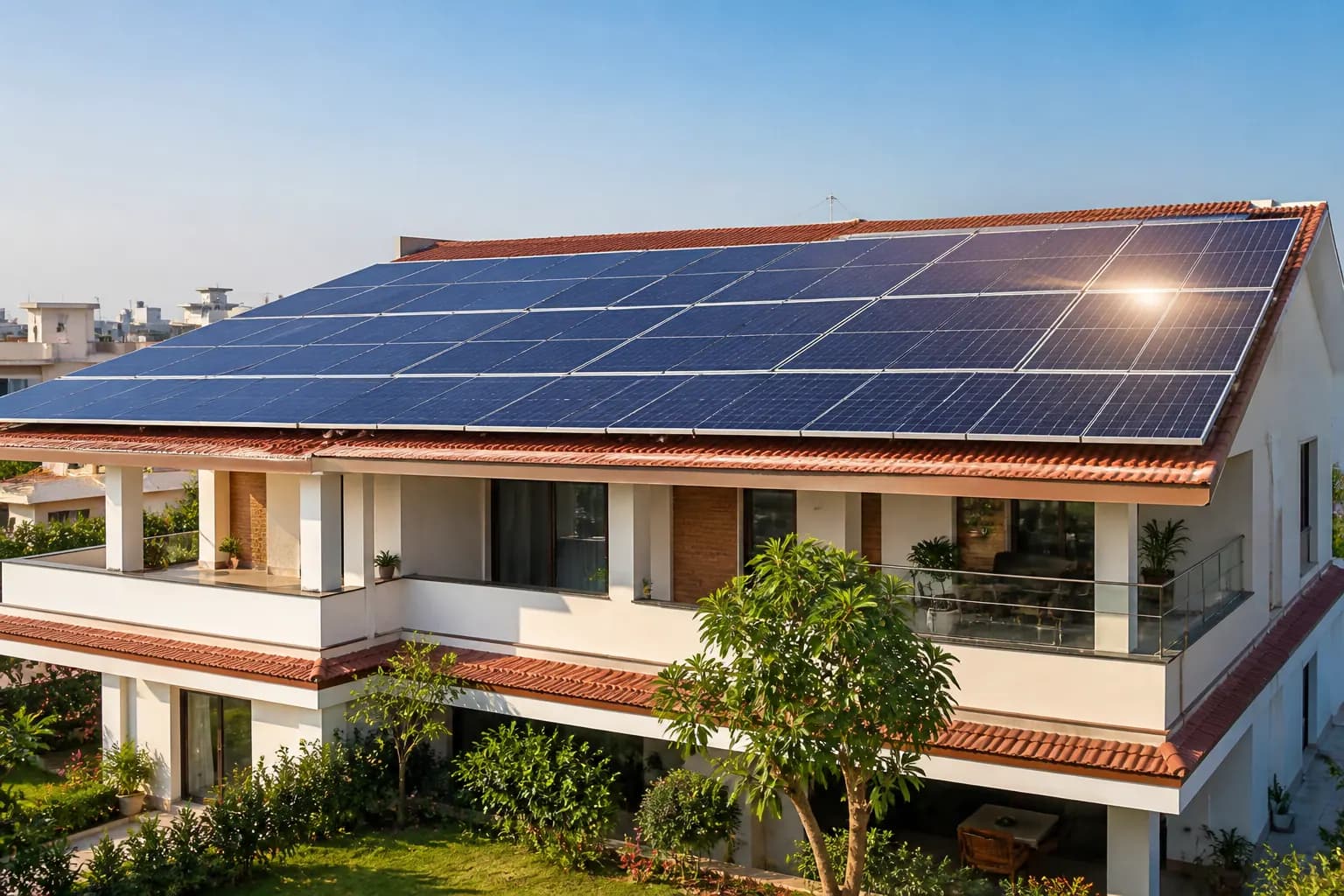
If your monthly electricity bill is around ₹5,000 in Jaipur, rooftop solar may be worth evaluating.
But there is an important mistake to avoid:
You should not select a solar system simply by matching a ₹5,000 electricity bill with a fixed kW capacity.
Two Jaipur households paying approximately the same amount can have different electricity consumption, tariff structures, seasonal usage patterns and rooftop conditions.
The right approach is to look at the electricity units you consume, when you use electricity, your available rooftop space and your future requirements.
This guide explains how to think about solar system sizing when your electricity bill is around ₹5,000 per month.
Why Your Electricity Bill Alone Cannot Determine Solar System Size
Your bill amount is useful, but it does not tell the complete story.
The amount payable on an electricity bill can be affected by several factors, including:
- Electricity consumption
- Applicable tariff
- Fixed charges
- Billing period
- Seasonal usage
- Other applicable charges
Therefore, two consumers with a ₹5,000 bill may not necessarily have identical electricity requirements.
When evaluating rooftop solar, your electricity consumption in units is generally more useful than looking only at the rupee amount.
Start by Checking Your Electricity Consumption
Take out several recent electricity bills.
Instead of looking only at the final amount payable, check how many units of electricity were consumed during each billing period.
Do not base the entire solar decision on one bill.
Electricity consumption can change significantly throughout the year.
For example, Jaipur households may have higher electricity consumption during periods when air conditioners and cooling equipment are used more frequently.
Reviewing several billing periods can provide a better understanding of your actual consumption pattern.
Why a ₹5,000 Bill Does Not Automatically Mean You Need 5kW Solar
The similarity between a ₹5,000 electricity bill and a 5kW solar system can be misleading.
Solar capacity is not selected by matching the numerical value of the electricity bill with the kW rating of a system.
A 5kW system may be suitable for one property and unsuitable for another property with a similar electricity bill.
The appropriate capacity depends on factors such as:
- Electricity units consumed
- Daytime electricity usage
- Rooftop space
- Shading
- Property type
- Sanctioned load
- Future electricity requirements
- System configuration
If you're specifically evaluating a 5kW system, read our 5kW solar panel price in Jaipur guide.
Should You Look at One Month or a Full Year of Electricity Bills?
Looking at multiple bills is preferable.
Electricity usage can vary considerably between summer and winter.
A household may use several air conditioners during Jaipur's hotter months but consume much less electricity during other parts of the year.
If you size a solar system based only on the highest-consumption month, the result may be different from sizing it according to the property's broader annual consumption pattern.
A solar assessment should therefore consider representative electricity usage rather than a single unusually high or low bill.
Daytime Electricity Usage Matters
Rooftop solar generates electricity when solar energy is available.
Understanding when your property consumes electricity can therefore be useful when evaluating a system.
Consider questions such as:
- Is someone usually at home during the day?
- Do you work from home?
- Are air conditioners used heavily during daytime hours?
- Are water pumps operated during the day?
- Is the property mostly empty until evening?
- Are you planning to charge an electric vehicle at home?
The answers help create a clearer picture of the property's electricity profile.
Check Your Rooftop Before Choosing System Capacity
Electricity consumption is only one side of solar system sizing.
Your rooftop also needs to support the proposed installation.
An installer should consider:
- Available rooftop area
- Shadow-free area
- Water tanks
- Staircase structures
- Parapet walls
- Nearby buildings
- Trees
- Rooftop equipment
- Panel orientation
- Maintenance access
A large rooftop does not automatically mean that the entire area is suitable for solar panels.
The usable solar area is what matters.
What if Your Rooftop Has Shadows?
Shading can affect solar electricity generation.
A rooftop may receive good sunlight during one part of the day but experience shadows from nearby buildings, trees or rooftop structures during another period.
This is why rooftop assessment should consider how shadows move rather than simply checking the roof at one moment.
System layout should be planned around the actual site conditions.
Should You Choose 3kW or 5kW Solar?
Many homeowners comparing residential solar systems consider capacities such as 3kW and 5kW.
Neither is automatically the correct choice.
A 3kW system may be suitable for one household, while another property may require 5kW or a different capacity.
The decision should be based on actual consumption and site conditions.
For more information about these capacities, read:
- our 3kW solar panel price in Jaipur guide
- our 5kW solar panel price in Jaipur guide
How Solar Generation Relates to Your Electricity Bill
A rooftop solar system generates electricity, while your electricity bill reflects electricity consumption and the applicable billing arrangement.
These concepts are related, but they are not identical.
The financial impact of solar can depend on factors such as:
- Actual solar electricity generation
- Electricity consumed directly by the property
- Electricity imported from the grid
- Applicable export or metering arrangements
- Electricity tariff
- Usage pattern
- System cost
This is why a responsible solar assessment should not promise that installing a particular capacity will automatically reduce every ₹5,000 bill to a specific fixed amount.
For a detailed explanation of solar output, read our solar panel electricity generation in Jaipur guide.
What About Net Metering?
Grid-connected rooftop solar may operate with the electricity grid according to applicable metering arrangements and regulations.
During periods when the solar system generates electricity, the property may consume part of that electricity directly.
Depending on the applicable arrangement, surplus generation may interact with the grid, while electricity can also be imported when the property's demand exceeds available solar generation.
The exact accounting depends on applicable regulations and the consumer's connection.
Read our guide explaining how net metering works for a deeper understanding.
Is Residential Solar Subsidy Available in Jaipur?
Eligible residential consumers may qualify for support under applicable rooftop solar programmes, subject to prevailing government rules and eligibility requirements.
Subsidy should not be assumed solely because a particular system capacity is being considered.
Eligibility, applicable capacity limits, technical requirements and the process should be checked according to the current programme rules.
For more information, read our Rajasthan solar subsidy guide.
What if Your Electricity Bill Is Increasing?
An increasing electricity bill can have several possible causes.
Your electricity consumption may have increased because of:
- Additional air conditioners
- Longer AC usage
- New appliances
- More occupants
- Work-from-home requirements
- Pumps or motors
- EV charging
- Changes in usage habits
Before choosing solar, understand why consumption has changed.
This also helps determine whether your future electricity requirements may be higher than your historical usage.
Should You Install a Larger System for Future Requirements?
Future electricity consumption can be considered during solar planning.
For example, you may be planning to:
- Buy an electric vehicle
- Add another air conditioner
- Expand part of your home
- Add a home office
- Install additional electrical equipment
However, future capacity planning should still take into account rooftop space, technical feasibility, applicable rules and your realistic expected consumption.
Installing the largest system that physically fits on the roof is not automatically the best approach.
On-Grid, Off-Grid or Hybrid?
System capacity and system type are two different decisions.
On-grid solar is connected to the electricity grid and is commonly considered where reducing dependence on grid electricity is the primary objective.
Off-grid systems incorporate battery storage and are designed around backup as well as generation requirements.
Hybrid systems can combine solar, grid interaction and battery functionality depending on their design.
If backup during power cuts is important, discuss that requirement before finalising the system configuration.
Can Solar Eliminate Your Electricity Bill Completely?
Homeowners should be careful with claims that a rooftop solar installation will automatically result in a zero electricity bill.
Your final electricity bill can depend on several factors beyond the rated solar capacity, including:
- Electricity consumption
- Solar generation
- Grid imports
- Applicable metering arrangement
- Fixed charges
- Tariffs
- Billing rules
- Seasonal variation
Solar can help reduce dependence on grid electricity, but the financial outcome should be evaluated using the property's actual circumstances.
Use a Solar Calculator as a Starting Point
An online solar calculator can help provide an initial estimate based on your electricity usage.
However, it should be treated as a starting point rather than a substitute for a rooftop assessment.
Use the SolarOnn solar calculator to get an initial indication of your solar requirement.
The next step should be to review the property, electricity bills and rooftop conditions before finalising system capacity.
Why Choose SolarOnn for Residential Solar in Jaipur?
SolarOnn provides rooftop solar solutions for homes across Jaipur.
Instead of recommending a system solely according to an advertised package or monthly bill amount, our approach focuses on understanding the property's electricity requirements and rooftop conditions.
This can help determine a more appropriate solar configuration for the individual property.
Learn more about our residential solar installation in Jaipur services.
If you're comparing installers, you can also read our guide on how to choose a solar company in Jaipur.
Get a Solar Assessment for Your Jaipur Home
If your electricity bill is around ₹5,000 per month and you're considering rooftop solar, start by keeping your recent electricity bills ready.
SolarOnn can review your electricity requirements and rooftop conditions to help determine an appropriate solar system for your property.
FAQ
Article FAQs
Quick answers related to this solar guide.
There is no single capacity that applies to every ₹5,000 electricity bill. The appropriate solar size depends on electricity units consumed, usage pattern, rooftop conditions, sanctioned load and other property-specific factors.
Still have questions?
Contact Our Solar ExpertsOr browse the complete FAQ hub for detailed answers by topic.
Related articles
Continue exploring SolarOnn’s solar energy blog for Jaipur.
5kW Solar Panel Price in Jaipur: Cost, Subsidy & Savings Guide
Planning a 5kW solar system in Jaipur? Learn what affects 5kW solar panel cost, subsidy eligibility, rooftop requirements, savings and installation.
3kW Solar Panel Price in Jaipur: Cost, Subsidy & Savings Guide
Planning a 3kW solar system in Jaipur? Understand the factors affecting 3kW solar panel price, subsidy eligibility, savings, rooftop requirements and installation.
How Much Electricity Can Solar Panels Generate in Jaipur?
How much electricity can solar panels generate in Jaipur? Learn what affects solar output, including system size, sunlight, shading, orientation and maintenance.